

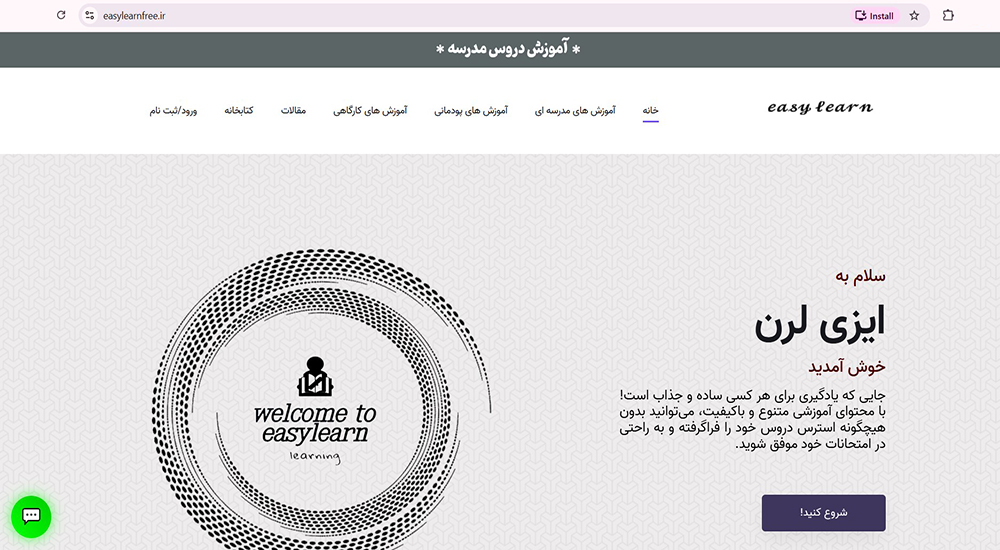


Easy Learn Scientific Educational Website Design
Today, education is no longer limited to classrooms and printed books. A significant part of the learning process now takes place through online platforms. A professional educational website should go far beyond displaying a few articles or educational files. It should provide an integrated environment for learning, interaction, assessment, and access to educational and scientific resources.
For this reason, educational website design requires a deep understanding of the target audience, educational structure, user experience, and technical features needed by students and educational administrators.
One notable example in this field is the Easy Learn scientific educational website, which was designed and developed by Mohammad Sadegh Moshtaghi. The website was created to provide a comprehensive educational platform for students in the first and second levels of secondary education. Alongside school-based educational content, the platform also provides modular and workshop-based training, educational articles, and an online library.
The current structure of the website brings different educational sections together with articles, a digital library, and user registration and login systems within a unified environment.
Easy Learn Educational Website Design with a Modern Learning Approach
In the Easy Learn educational website design project, particular attention was paid to creating a structure that meets the real needs of students. The main objective was to provide easier access to academic and practical training while creating features that transform the traditional learning process into an organized digital experience.
The name of this educational website is Easy Learn, and the platform was designed and developed to provide general education for students across the first and second levels of secondary school.
The educational architecture of the project incorporates modern learning approaches such as Microlearning and E-learning. These approaches make educational content more accessible and allow students to find and use learning resources according to their individual needs.
In addition to school-based education, Easy Learn also covers modular and workshop-based training. As a result, the website is not limited to being a resource for school subjects. It can also serve as a platform for practical learning and skill development.
Artificial Intelligence in Easy Learn Educational Website Design
One of the important features of this project is the use of Artificial Intelligence (AI) within the educational platform. Today, combining artificial intelligence with online education can create new opportunities for faster interaction between users and educational content.
In Easy Learn, AI has been considered for support, teaching assistance, and the development of a general-purpose chatbot.
Such functionality can make the user experience more personalized and interactive. Instead of interacting only with static pages and one-way content, students can use an interactive environment to receive guidance and find answers to their questions.
This capability is particularly valuable for educational platforms whose primary audience consists of students, as interactive learning tools can make the educational experience more engaging and accessible.
A Powerful User Panel for Students
One of the most important components of educational website design is the user panel. A professional educational website should be able to manage user information while providing students with the features they need in a simple and understandable environment.
In the Easy Learn project, a powerful user panel was developed to manage students’ interactions with the platform.
Through this panel, students can interact with various website features, communicate with others, upload educational files, edit their user information, and participate in examinations.
This structure means that users do not need to rely on multiple separate systems to perform different educational activities.
In fact, the purpose of the user panel in this project is not simply account management. It serves as the primary interface between students and the educational system. This is one of the major differences between a simple content-based website and a professional educational platform.
Educational Articles and Content Management System
Text-based educational content is one of the fundamental components of a successful educational website. For this reason, Easy Learn includes a professional system for publishing and managing educational articles.
This section is controlled by the website administrator, allowing content to be uploaded and edited through the administration panel.
Centralized article management enables the website administrator to update educational content without depending on a programmer. Combined with SEO best practices, this functionality can contribute to improving the website’s visibility in search engine results.
Many educational websites use articles alongside their primary courses and educational resources to attract users through Google and other search engines.
The Easy Learn article section also includes a commenting system. Its automated notification system is connected to email or SMS, allowing users or administrators to receive notifications about events such as submitting comments, receiving feedback, or editing responses.
This feature can help increase communication and engagement between website users and administrators.
Online Library for Easy Access to Educational Resources
Another important component of the Easy Learn project is its online library.
A digital library within an educational platform allows study resources to be placed alongside the primary learning content, making it easier for students to access the materials they need.
Users can read books and search the website’s book database through this section.
This functionality transforms the website from a simple educational website into a more comprehensive learning resource. Students can not only access academic content but also find relevant study materials within the same platform.
Custom Exams and Questionnaires in Easy Learn
Assessment is an essential part of the learning process. A professional scientific educational website can provide a more complete learning experience when it offers assessment tools alongside educational content.
For the Easy Learn project, a professional questionnaire system was designed and developed from scratch. The system can be used in different scenarios, including educational processes, user evaluation, and information gathering.
Because the system was developed with scalability in mind, it can also be enhanced and expanded in the future.
In addition to questionnaires, students can participate in examinations through their user panel. This allows the complete learning journey—from receiving educational content to evaluating student performance—to take place within a single platform.
Responsive Educational Website Design for Mobile and Tablet
Today, a significant percentage of educational website users access online content through smartphones. Therefore, responsive design is no longer an optional feature for an educational website. It is one of the essential requirements of modern educational website development.
In the Easy Learn project, clean programming practices and a responsive structure were implemented. As a result, the platform can be accessed and used on smartphones and other devices.
This feature is particularly important for students because access to educational content should not be restricted to a specific device.
Professional Backend and Complete User Management
An attractive interface is only one part of a successful educational website. Behind every professional platform is a powerful backend responsible for managing users, content, examinations, articles, and other system information.
Easy Learn includes a professional backend for managing users and controlling different sections of the website.
This architecture allows administrators to manage various processes through the administration panel and makes it possible to add new features whenever necessary.
One of the important characteristics of the project is its scalability. All sections of the website were developed with a scalable architecture, and the platform has been updated four times so far.
This approach demonstrates that the Easy Learn educational website was not designed as a static project. Instead, it was built as a platform capable of continuous improvement and development.
User Authentication and Security in Easy Learn
User security is extremely important for an educational platform because account information, files, examinations, and student activities may be stored within the system.
For this reason, email verification has been implemented for user registration and login in the Easy Learn user panel.
During the verification process, a confirmation code is sent to the email address entered by the user. This helps verify the user’s identity and provides an additional layer of protection against fake registrations and unauthorized access.
SEO in Easy Learn Educational Website Design
SEO is one of the most important factors in the success of an educational website.
Even when an educational platform offers excellent technical features, a significant portion of its potential may remain unused if users cannot discover it through search engines.
Easy Learn was developed with an SEO-oriented approach, while its content structure also provides strong potential for attracting users through search engines.
The presence of educational articles, school-based training categories, modular training, workshop-based education, and an online library creates valuable opportunities for targeted content creation and organic search traffic.
The website also presents these categories separately within its main structure.
In professional educational website design, SEO should be considered from the early stages of information architecture and technical development rather than being treated as an activity that begins only after the website is launched.
Page structure, website performance, mobile compatibility, internal linking, logical content categorization, and the ability to continuously expand the article section can all contribute to long-term organic growth.
Technologies Used in Easy Learn Website Development
A combination of widely used and powerful web technologies was employed to develop this project.
The main technologies used include:
- HTML
- CSS
- PHP
- JavaScript
- Bootstrap
HTML is responsible for the structure of the web pages, while CSS handles the visual design and appearance of different components. JavaScript is used to create client-side interactions, and PHP plays an important role in server-side and backend development.
Bootstrap was also used to help create a responsive structure compatible with different devices and screen sizes.
In addition to these core technologies, modern educational technologies such as AI, E-learning, and Microlearning have been incorporated into the project’s overall concept.
Combining these technologies has helped transform Easy Learn from a simple content publishing website into a more interactive, scalable, and comprehensive educational platform.
Why Is Easy Learn an Important Educational Website Design Project?
The main difference between this project and a basic educational website lies in the combination of multiple capabilities within a single system.
Students can access educational content, participate in examinations, interact with the platform, upload educational files, use the online library, and benefit from artificial intelligence features—all within the same environment.
At the same time, administrators have appropriate control over users, articles, and published educational content.
The project’s focus on responsive design, security, SEO, scalability, and content management also demonstrates that the development process was not focused solely on visual appearance.
In professional educational projects, information architecture and user experience play a crucial role. The ultimate goal should be to create a simple, clear, and effective learning journey for users.
Educational Website Design Focused on the Future of Learning
Online education is rapidly evolving, and educational platforms need to keep pace with changing user expectations.
The integration of artificial intelligence, e-learning, microlearning, examination systems, digital libraries, and dedicated user panels demonstrates that the next generation of educational websites needs to combine content, technology, and user experience.
The Easy Learn project was developed with this approach in mind.
The ability to improve different sections, the updates that have already been implemented, and the use of a scalable architecture make it possible to introduce additional features and capabilities to the platform in the future.
Overall, Easy Learn educational website design is an example of a custom educational platform that brings together education, interaction, assessment, study resources, user management, artificial intelligence, and SEO within an integrated structure.
The project was designed and developed by Mohammad Sadegh Moshtagh, using technologies including HTML, CSS, PHP, JavaScript, and Bootstrap.
The result is an educational platform designed not only to address the current needs of students but also to provide the technical foundation required for future growth and the development of new educational features.


